Brand Architecture in the AI Era: Why It Works Differently Today
Brand architecture is one of the fundamental concepts of brand management. It describes the structure a company uses to relate its brands, products and services to one another. For companies with a growing portfolio, and in the age of AI, one central question arises: how can several offerings be organized so that customers can place them easily and still recognize them in the future?
In practice, many of the companies long seen as textbook examples of certain architecture models have changed their strategy in recent years. FedEx, Apple, Marriott: they all appear in classic frameworks as examples of sub-brands, endorsed brands, or branded houses. Take a closer look, though, and some of these classifications no longer reflect reality.
These changes raise a few questions: What brand architecture models exist today? How have well-known companies evolved? And what criteria should you use to choose the right brand architecture?
On top of that, one factor is speeding things up even further: artificial intelligence. With AI tools, companies can now design new products, test business models, and bring digital offerings to market in record time. Where this used to take months or years, new products now launch every day, and with them, new brands. For companies, this means the question of the right brand architecture comes up not only more often, but more urgently than ever.
What Is Brand Architecture? A Clear Definition.
Brand architecture describes how a company applies its branding across a collection of products, services, or business units. It defines how the different brands in a portfolio relate to each other and to the company itself.
One frequently cited criterion for successful brand architecture is how easy it is to follow: the simpler the structure is to explain, the easier it is for customers, partners, and employees to understand and use.
Why Does Brand Architecture Matter?
In his influential book How Brands Grow, brand researcher Byron Sharp showed that brand growth depends mainly on two factors: physical availability (consumers can find the brand easily) and mental availability (the brand comes to mind quickly in buying situations).
Brand architecture directly affects both. As soon as a company has more than one product or brand, it faces a strategic decision: How do I organize my brands so they’re as easy as possible for customers to understand, find, and remember?
The Classic Models of Brand Architecture
Traditionally, there are four basic models of brand architecture:
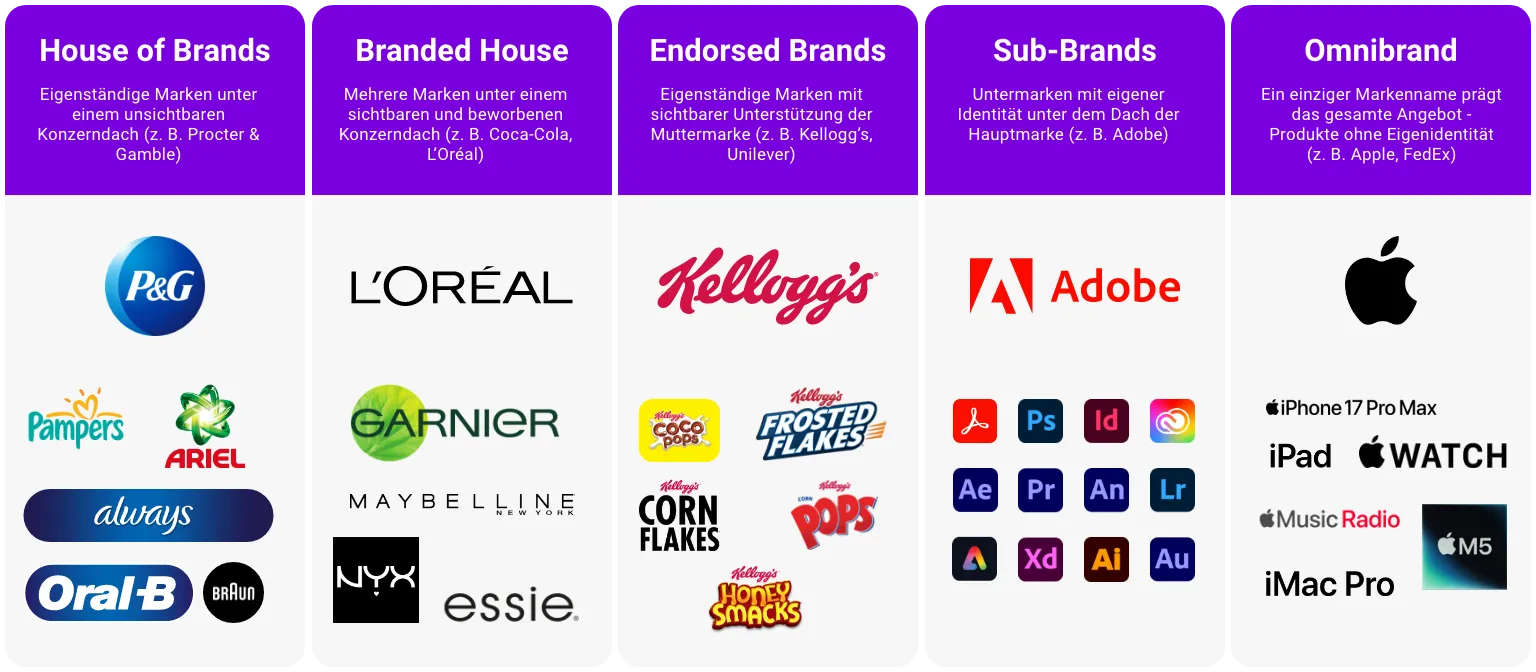
Branded House: A single brand name sits above everything. All products and services go to market under this master brand. Recognition is high, and marketing budgets are pooled.
House of Brands: The company runs several independent brands, each with its own identity. The corporate brand barely shows up for end customers. Procter & Gamble is often cited as an example: most consumers know Ariel, Pampers, or Gillette, but aren’t necessarily aware that they belong to P&G.
Endorsed Brands: Each brand has its own identity but is backed by a visible link to the parent brand. Kellogg’s is a good example: the company name appears prominently on all of its products.
Sub-Brands: Sub-brands benefit from the reputation of the main brand but have their own distinct positioning. Adobe, with products like Photoshop, Illustrator, and Premiere Pro, is often cited as an example, since each product has its own visual identity.
What Has Changed: The Rise of the Omnibrand
Alongside the four classic models, another development has emerged in recent years that can be described as the omnibrand.
Apple is a common example: the Mac, iPad, and iPhone were long considered classic sub-brands. Look at the products today, and you’ll notice they barely have a visual identity of their own apart from the Apple master brand. Design, ecosystem, and brand experience are consistent across the board. The thinking behind it: instead of spreading resources across several sub-brands, all marketing is concentrated on a single brand.
FedEx shows a similar pattern: where there used to be various sub-brands (FedEx Express, FedEx Ground, etc.), everything now appears uniformly under the FedEx umbrella.
The omnibrand follows a logic similar to P&G’s house of brands model, but in reverse: while P&G strengthens each product brand individually and keeps the corporate brand in the background, the omnibrand pools all its resources into one overarching brand name.
Brand Architecture Compared: P&G vs. Unilever
Comparing Procter & Gamble and Unilever shows how differently companies can design their brand architecture. P&G consistently follows the house of brands model: each brand stands on its own, has its own profit and loss statement, and is managed independently. For most consumers, the P&G corporate brand is barely visible. The reasoning: every square inch of packaging or ad space used for the corporate brand is a square inch the individual product brand can’t use.
Unilever, on the other hand, leans more toward an endorsed brand strategy and puts the Unilever logo on most of its products. Both approaches have their merits, and each comes with its own pros and cons. While the house of brands strategy gives each individual brand maximum flexibility, the endorsed brand strategy can build trust through the visibility of the parent brand. Over longer periods, P&G has outperformed Unilever on several metrics, although the reasons are many and likely can’t be attributed to brand architecture alone.
Artificial Intelligence and the Brand Architecture of the Future
One factor likely to make well-thought-out brand architecture even more important in the coming years is the impact of artificial intelligence on product development and business strategy.
AI-powered tools already let companies develop new products, services, and entire business lines far faster than before. What once required extensive market research, long development cycles, and major investment can now be done with AI in a fraction of the time, from ideation and prototyping all the way to launch. The result: new products and brands are entering the market at an unprecedented pace.
This has far-reaching consequences for brand architecture. When companies launch new offerings at shorter intervals, the same question comes up every time: Does the new product go under the existing master brand? Does it need its own brand? Or should it become a sub-brand? Without a clear brand architecture, the portfolio risks becoming confusing, for customers and for the company itself.
At the same time, the AI-driven flood of new products is intensifying competition considerably. In a market where new offerings keep appearing, it gets harder for individual brands to stay visible and stand out from the crowd. This is exactly where brand architecture becomes the decisive lever: it ensures that new products don’t stand alone in the market, but benefit from the awareness and trust that existing brand structures have already built.
Companies using AI to expand their offering quickly therefore face a dual challenge. On the one hand, they need to harness the speed of AI-driven development. On the other, they need a brand architecture that can keep up with that pace: a structure flexible enough to take on new products, yet clear enough to give customers orientation. Companies that manage both gain an edge in a market defined by increasing speed and an ever-growing range of offerings.
What Does This Mean for Your Own Brand Architecture?
One striking trend in brand architecture today is the move toward simpler structures. Several of the world’s best-known companies (from Apple in tech to P&G in consumer goods) have streamlined their architecture in recent years.
One aspect that’s often underestimated when planning a brand architecture is cost: running a second brand usually means a second marketing budget, its own positioning, and its own ongoing upkeep.
So the key question when choosing a brand architecture is this: Which structure makes it easiest for your customers to understand, find, and place your offering? The answer varies by industry, audience, and company size. The underlying principles, however, apply to global corporations and growing mid-sized businesses alike.